
Cyber attacks are getting more sophisticated. Imagine a world where cybercriminals can craft phishing emails indistinguishable from your coworker’s messages, or generate deepfake videos of your CEO demanding urgent wire transfers. This isn’t science fiction—it’s the reality of AI-powered cyber attacks in 2025. As artificial intelligence evolves, so do the threats. But here’s the good news: AI isn’t just a weapon for attackers—it’s also our best defense.
In this post, we’ll unpack the rise of AI-driven threats, explore cutting-edge solutions like XDR and Zero Trust, and clarify the differences between MDR, XDR, EDR, and traditional antivirus. Whether you’re an MSP or a business leader, understanding this dynamic is critical to staying secure.
AI-powered cyber attacks leverage machine learning and generative AI to automate, scale, and refine malicious activities. Unlike traditional attacks, which rely on manual effort, these threats adapt in real time, making them faster, stealthier, and far more dangerous.
Here’s what’s keeping cybersecurity experts up at night:
Hyper-Personalized Phishing: Attackers use generative AI tools like ChatGPT to craft convincing, grammatically flawless emails tailored to individual targets. For example, a scammer might impersonate a company’s CFO using AI-generated voice clones to trick employees into transferring funds.
Deepfake-Driven Fraud: AI-generated videos, audio, or images can mimic executives or trusted figures. A recent Forbes report highlighted a case where a deepfake CEO authorized a $35 million transaction, bypassing traditional verification.
Automated Vulnerability Scanning: AI systems can scan networks 24/7, identify weaknesses (like unpatched software), and exploit them faster than human teams can respond.
The result? Attacks that are harder to detect, easier to scale, and devastatingly effective.
Can AI Prevent Cyber Attacks?
Absolutely—but it’s a double-edged sword. While AI empowers attackers, it also equips defenders with tools to predict, detect, and neutralize threats.
The key lies in how organizations deploy AI:
Predictive Analytics: AI analyzes historical data to forecast attack patterns. For instance, CrowdStrike’s 2025 Global Threat Report notes that AI-driven systems can now predict ransomware campaigns weeks in advance.
Real-Time Threat Hunting: Unlike traditional antivirus (which relies on known malware signatures), AI-powered systems like XDR detect anomalies in real time. Think of it as a security guard that never sleeps.
Automated Response: When a threat is detected, AI can isolate infected devices, revoke access, or patch vulnerabilities—all without human intervention.
But AI isn’t a silver bullet. It requires human oversight, quality data, and integration with frameworks like Zero Trust to work effectively.
How Can AI Prevent Cyber Attacks?
Let’s get tactical. Here’s how AI is transforming defense strategies:
Behavioral Analysis: AI monitors user activity to spot deviations. If an employee suddenly downloads gigabytes of data at 2 a.m., the system flags it.
Natural Language Processing (NLP): Tools like SentinelOne’s XDR platform analyze email content to detect phishing attempts, even if they’re not yet classified as threats.
Threat Intelligence Sharing: AI aggregates data from global attacks to identify emerging trends. For example, if a new ransomware variant hits Europe, AI updates defenses worldwide within minutes.
The catch? Attackers are using the same techniques. That’s why pairing AI with frameworks like Zero Trust (which assumes no one is trustworthy by default) is essential.
AI-Powered Cyber Attacks: Threats and Measures
Emerging Threats
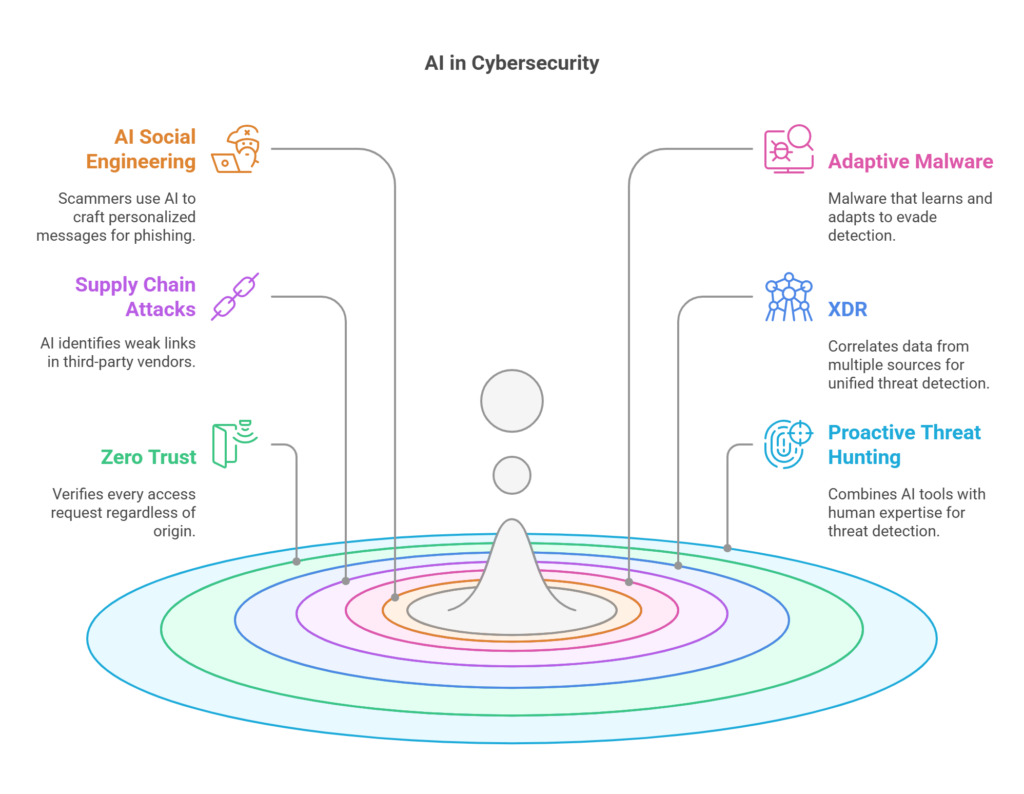
AI-Enhanced Social Engineering: Scammers use AI to analyze social media profiles and craft personalized messages. A hacker might target a finance team member with a fake invoice mirroring their vendor’s writing style.
Adaptive Malware: Malware that learns from its environment. If it detects a sandbox (a testing environment), it lies dormant until it reaches a real target.
Supply Chain Attacks: AI identifies weak links in third-party vendors. The 2023 SolarWinds breach, amplified by AI, could become the norm.
Defensive Measures
Extended Detection and Response (XDR): Unlike EDR (which focuses on endpoints), XDR correlates data from emails, clouds, networks, and apps. For MSPs, platforms like Microsoft’s XDR offer a unified view of threats.
Zero Trust Architecture: Every access request is verified, regardless of origin. The UK’s NCSC calls Zero Trust “non-negotiable” for modern security.
Proactive Threat Hunting: MSPs are offering MDR (Managed Detection and Response), combining AI tools with 24/7 human experts.
MDR vs. XDR vs. EDR vs. Antivirus: A Cheat Sheet
Confused by the acronyms? Let’s break it down:
| Solution | Coverage | Key Features | Best For |
|---|---|---|---|
| Antivirus | Endpoints | Scans for known malware signatures | Basic protection, small budgets |
| EDR | Endpoints | Detects advanced threats, provides incident response tools | Businesses needing deeper endpoint security |
| MDR | Endpoints, Network, Cloud | 24/7 monitoring + human experts | Organizations lacking in-house IT |
| XDR | Cross-platform (Full stack) | Integrates all security data, AI-driven analytics | Large enterprises, complex ecosystems |
Source: CrowdStrike’s EDR vs. MDR vs. XDR Guide
Why This Matters for MSPs:
Antivirus is like locking your front door—it’s essential but insufficient alone.
EDR adds motion sensors and cameras (focused on endpoints).
MDR is a 24/7 security team monitoring those cameras.
XDR is a smart home system that monitors doors, windows, and the backyard.
Using AI to Prevent Cyber Attacks: A Blueprint for MSPs
For Managed Service Providers, the stakes are high. Clients expect you to outthink AI-driven threats. Here’s how to step up:
Adopt XDR Early: Platforms like Cynet XDR unify siloed tools, reducing response time.
Enforce Zero Trust: Implement strict access controls and MFA. Tools like Zscaler make this scalable.
Train Clients: Simulate AI-driven phishing attacks to build resilience.
Leverage Threat Intelligence: Subscribe to AI-powered feeds like Recorded Future for real-time alerts.
Real-World Success: A mid-sized MSP thwarted a ransomware attack using XDR’s AI analytics, isolating the threat before encryption began. The client never knew they were targeted.
Conclusion: The Future is AI vs. AI
The cybersecurity arms race has entered a new era. As attackers weaponize AI, defenders must fight fire with fire—deploying AI-driven tools like XDR, adopting Zero Trust, and understanding the nuanced roles of MDR, EDR, and antivirus.
For MSPs, this isn’t just a technical challenge—it’s a business opportunity. Clients will flock to providers who offer proactive, AI-enhanced security. The question isn’t if AI will reshape cybersecurity—it’s when you’ll adapt.
Ready to fortify your defenses? Start by auditing your current stack, invest in XDR, and remember: in the age of AI, standing still is the biggest risk of all.